Decision Models
A decision model reads a state plus typed questions (one of N options, yes/no, an ordered scale, a checklist) and returns a calibrated probability for every answer, in one forward pass and without generating text. Examples are TypeSafe Jev, Cloudflare Clef (open weights) and Microsoft-Decision-1. For routing, classification and gating they are one to two orders of magnitude cheaper and faster than an LLM call.
In Flock a decision is a shared fact on the blackboard: one agent decides once and publishes the decision. Other agents subscribe to an option of that decision.
from pydantic import BaseModel

from flock import Choice, Flock, flock_type


@flock_type
class Ticket(BaseModel):
    subject: str
    body: str


@flock_type
class Reply(BaseModel):
    team: str
    reply: str


class Route(Choice):
    """Which team should handle this support ticket?"""

    billing = "Charges, invoices, refunds"
    shipping = "Delivery, tracking, returns"
    tech = "Bugs, crashes, login problems"


flock = Flock("openai/gpt-4.1")

triage = (
    flock.agent("triage")
    .consumes(Ticket)
    .decides(Route, model="azure/decision-1", threshold=0.8)
)

flock.agent("billing").consumes(Route.billing).publishes(Reply)
flock.agent("tech").consumes(Route.tech).publishes(Reply)
flock.agent("supervisor").consumes(Route.UNSURE).publishes(Reply)
Question types
A question class is the question and its answers; its docstring is the question sent to the model. The three kinds map to the native question types of the decision APIs:
| Class | Answers | systemone | OpenAI Decisions | Subscription handles |
|---|---|---|---|---|
Choice | one of 2-255 options | choice | choice | Route.billing, Route.UNSURE, Route.ANY |
YesNo | yes or no | noul | predicate | Urgent.yes, Urgent.no, Urgent.UNSURE, Urgent.ANY |
Scale | 2-10 ordered levels | score | score | Anger.angry, Anger.angry.or_higher, Anger.annoyed.or_lower, Anger.UNSURE, Anger.ANY |
Checklist | yes/no per item, any number of items, one decision | noul per item | predicate per item | Controls.passed, Controls.failed, Controls.mfa, Controls.mfa.no, Controls.mfa.UNSURE, Controls.UNSURE, Controls.ANY |
UNSURE and ANY are reserved names, and so are passed and failed in a Checklist.
Choice
- Every string attribute is an option. Its value describes the option and is sent as the option's criteria. Good descriptions matter as much as good prompts.
- Options are static. A Choice needs at least two options. Decision models accept at most 255 options per question; a larger Choice is asked as a tournament.
Choice.from_options("Route", {"billing": "...", "tech": "..."}, question="...")builds a Choice from data, for example a catalog loaded at startup.
YesNo
from flock import YesNo


class Urgent(YesNo):
    """Does the customer need an answer today?"""


class Refund(YesNo):
    """Does the customer ask for a refund?"""

    yes = "They want money back"   # optional: what each answer means
    no = "No refund request"
The model returns the probability of yes; the decision carries probabilities = {"yes": p, "no": 1 - p}. systemone models receive the descriptions as noul criteria. OpenAI predicates take no descriptions, so Flock appends them to the instructions. A YesNo accepts no other attributes.
Ask a yes/no question as YesNo rather than as a two-option Choice: the native yes/no head of a decision model and its choice head can disagree on the same item.
Scale
from flock import Scale


class Anger(Scale):
    """How angry is the customer?"""

    calm = "Calm and polite"            # lowest level first
    annoyed = "Annoyed but civil"
    angry = "Angry, complaining strongly"
    furious = "Furious, threatening to leave"
A Scale has 2-10 levels in declaration order, lowest first. The decision carries the probability per level, the most probable level as choice and the probability-weighted score: 0 is the lowest level, 3 the highest here, and 2.2 lies between angry and furious.
Anger.angrytriggers when the most probable level isangry(and clears the threshold).Anger.angry.or_highertriggers whenscore >= 2,Anger.annoyed.or_lowerwhenscore <= 1. These compare the score and ignore the threshold: a decision split betweenangry(0.55) andfurious(0.45) isUNSUREas a level, but its score of 2.45 is clearly "angry or higher".
Checklist
A Checklist asks the same yes/no question for every item and publishes one decision with an answer per item. It is made for checking an artifact against a catalog: a document against security controls, a contract against required clauses, a release against a definition of done.
from flock import Checklist


class Controls(Checklist):
    """Does the document show that this control is implemented?"""

    mfa = "Multi-factor authentication is required for remote access"
    backup = "Backups are performed daily"
    restore_test = "Restores from backup are tested"


# or from a catalog; ids need not be identifiers ("ORP.1.A1" works, via getattr)
Controls = Checklist.from_items(
    "Controls",
    {control["id"]: control["text"] for control in catalog},
    question="Does the document show that this control is implemented?",
)
Every item becomes a yes/no question whose instructions are the docstring plus the item text. The more probable answer counts, firm when its probability reaches the threshold: with threshold=0.8 an item is yes at a probability of yes of at least 0.8, no at 0.2 or below, and UNSURE in between. The decision carries:
results:yes,noorUNSUREper item;probabilities: the probability of yes per item;choice, the outcome:failedas soon as one item isno,UNSUREif no item isnobut some are unsure,passedif every item isyes;refused_items: items the model refused (their result isUNSURE).
Subscribe to the outcome (Controls.failed), to one item (Controls.restore_test.no), or put a where= predicate on the decision: .consumes(Controls.ANY, where=lambda d: "UNSURE" in d.results.values()) routes every document with unsure items to a review, also when the outcome is already failed.
Use a Checklist, not a Choice, when several items can apply at once. A Choice asks which one option applies and spreads the probability over all options: with a policy text that satisfies 11 of 20 controls, Microsoft-Decision-1 put 0.40 on the best control and no option cleared a threshold of 0.8.
Many items are cheap, because the artifact is sent once as the state and each item is a question about it:
| Questions in one request (Microsoft-Decision-1) | Latency |
|---|---|
| 1 | 167 ms |
| 20 | 253 ms |
| 100 | 560 ms |
.decides(..., questions_per_request=100) (the default) splits larger checklists into requests of at most that many questions and sends them concurrently. On the example data below (24 documents, 100 controls each, threshold 0.8), Microsoft-Decision-1 found every implemented control (recall 1.00) at a precision of 0.75, about 600 ms per document. Many of the extra "yes" answers are arguable, such as a procedure document counted as documentation of operating procedures.
Deciding: .decides()
.decides(
    Route, Urgent, Anger,       # one or more question classes, asked in one request
    model="azure/decision-1",   # or a DecisionProvider; default: Flock(decision_model=...)
    threshold=0.8,              # optional, for every question; below it a decision is UNSURE
    instructions=None,          # optional, single question only; overrides the docstring
    visibility=None,            # optional; overrides visibility inheritance
    questions_per_request=100,  # optional; larger sets are split into concurrent requests
    tournament=None,            # optional; Tournament(...) asks one large Choice in rounds
    options=None,               # optional; callable(ctx) -> option names asked this time
)
.decides() sets the agent's engine to a DecisionEngine and makes the agent publish one Decision.of(<question>) per question. Utilities, guards and tracing work as for any other agent. A decision agent publishes only its decisions: .decides() cannot be combined with .with_engines() or .publishes(), in either order, and batch subscriptions are not supported.
The model sees the agent's inputs as its state, one line per input: Ticket: {"subject": "...", "body": "..."}.
Several questions in one call
With several questions the model answers all of them in one request, in one pass over the state, and every execution publishes one decision per question about the same subject. Each question routes on its own:
triage = flock.agent("triage").consumes(Ticket).decides(Route, Urgent, Anger)

flock.agent("billing").consumes(Route.billing).publishes(Reply)
flock.agent("pager").consumes(Urgent.yes).publishes(Page)
flock.agent("deescalation").consumes(Anger.angry.or_higher).publishes(Reply)
A ticket that is about billing, urgent and furious runs all three agents, each with the ticket as input. The question classes of one decider need distinct class names.
The decision artifact
Each decision is a Decision.of(<question>) artifact, for example Decision.of(Route):
| Field | Meaning |
|---|---|
question | Name of the question class |
kind | choice, yesno or scale |
choice | The selected option, or UNSURE when its probability is below threshold or the model refused |
best_guess | The model's pick, also when unsure; None when the model refused |
probabilities | Probability per option (per level for a Scale, yes/no for a YesNo) |
score | Scale only: the probability-weighted level, 0 = lowest |
refused | The model refused to answer this question |
results, refused_items | Checklist only: answer per item, items the model refused |
rounds | Tournament only: candidates, groups, refused groups, survivors and the top candidates of every group per round |
candidates | The options the decision was asked about when options= restricted them |
confidence | Confidence as reported by the model |
threshold | The threshold that applied |
subject_ids | Ids of the artifacts the decision is about |
model | The model that answered (as reported by the provider) |
tier, attempts | Escalation: the tier that answered (0 is the decider's model) and the earlier tiers' answers |
votes | Ensembles: every model's answer |
shadow | Shadow mode: the shadow model's answer, recorded but not routed |
latency_ms | Round trip of the decision request (shared by all questions of the request) |
Tournaments for large choices
Some decisions pick one option out of a large catalog: mapping a paragraph to the requirement it implements, with well over 1,000 requirements in the BSI IT-Grundschutz-Kompendium. A tournament asks such a Choice in rounds:
from flock import Choice, Tournament

Requirement = Choice.from_options("Requirement", catalog, question="Which requirement does this paragraph implement?")

flock.agent("mapper").consumes(Paragraph).decides(
    Requirement, tournament=Tournament(group_size=20, keep=3), threshold=0.6
)
- The options are split into groups of
group_size; every group is one choice question, and all groups of a round go out together (in requests of at mostquestions_per_requestquestions). A leftover group of one option cannot be asked as a choice and advances without a request. - The
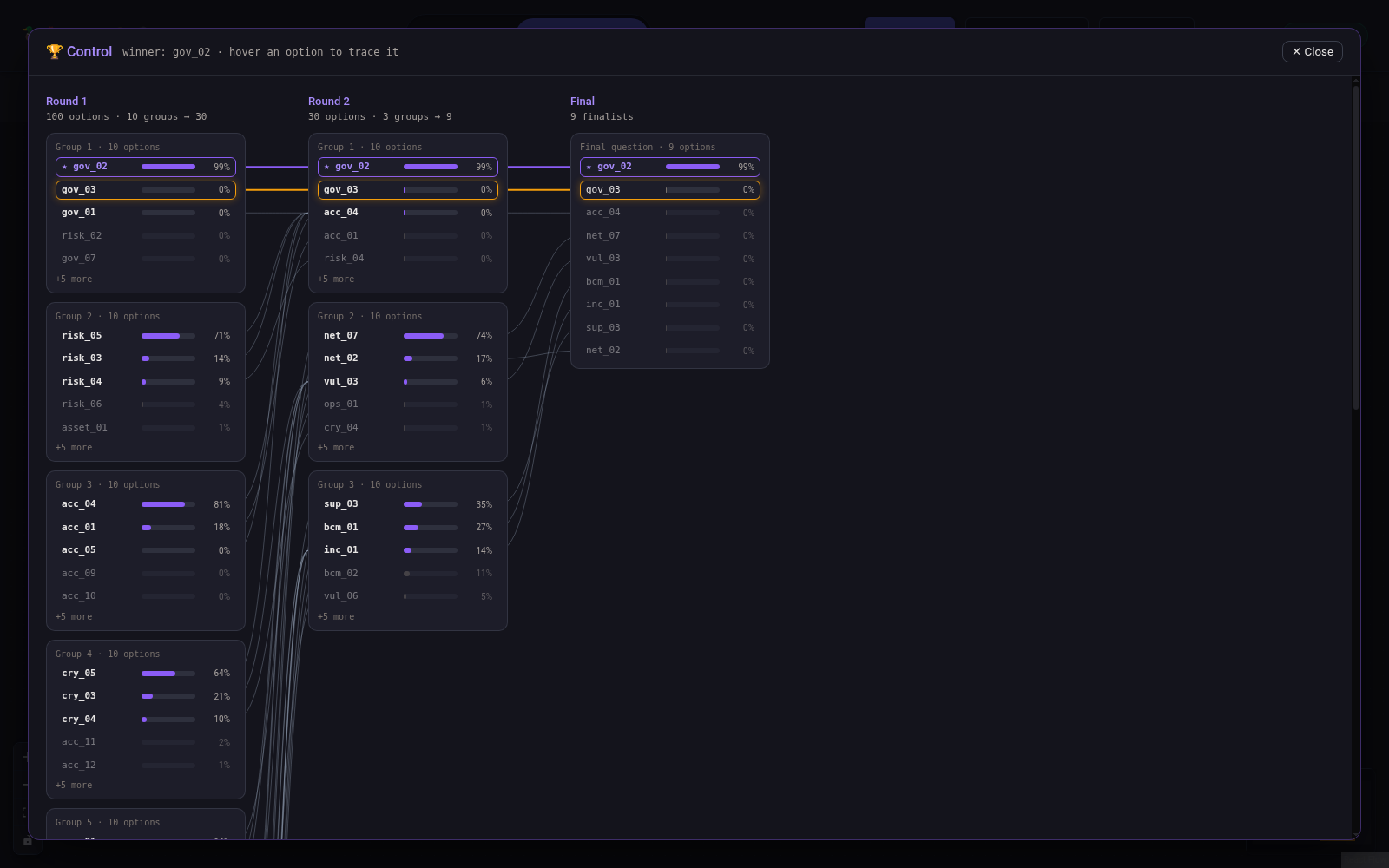
keepmost probable options of each group survive. The tournament keeps a top-k per group instead of applying a threshold, because probabilities are normalized within each group and cannot be compared across groups. - Rounds repeat until the survivors fit into one final question. Its answer is the decision: probabilities over the finalists, threshold and
UNSUREas usual, subscriptions and handles unchanged.
The decision's rounds lists every round's candidates, groups, group_size, refused_groups and survivors, and per group (group_results) its size and its top candidates with their probabilities: the survivors plus the two strongest eliminated options. OpenAI's Decisions API refuses a group in which no option fits; such a group keeps no survivors. A Choice with more than 255 options must be asked as a tournament or restricted with options=; .decides() without either rejects it.
A tournament costs one round trip per round, and an option that drops out early cannot win. On the example below (25 evidence sentences, 100 controls, Microsoft-Decision-1), both fit:
| Decider | Right | Median latency | Requests |
|---|---|---|---|
| one choice over all 100 controls | 25/25 | 180 ms | 1 |
| tournament, groups of 20, keep 3 | 25/25 | 419 ms | 2 |
Use a single choice whenever the options fit into one question, and a tournament or a screening network when they do not.
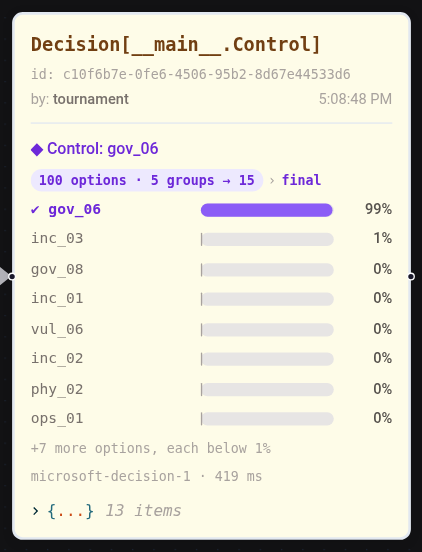
⤢ bracket on a tournament decision opens the whole tournament: one column per round and the final, group boxes with their top candidates, lines from every survivor to its place in the next round, and the winner's path highlighted. Hovering an option traces its path through all rounds:
Routing: choice subscriptions
flock.agent("billing").consumes(Route.billing)    # one option
flock.agent("supervisor").consumes(Route.UNSURE)   # decisions below the threshold
flock.agent("logger").consumes(Route.ANY)          # every decision
flock.agent("orders").consumes(Route.billing).consumes(Route.shipping)  # OR
A choice subscription triggers on matching decisions but delivers the decision's subject: the billing agent receives the Ticket, so its engine signature is Ticket -> Reply, exactly as if it consumed Ticket directly. The decision is on the context:
class BillingEngine(EngineComponent):
    async def evaluate(self, agent, ctx, inputs, output_group):
        ticket = inputs.first_as(Ticket)
        routed_with = ctx.decision.probabilities["billing"]
        ...
Consumption is recorded on the decision artifact, so lineage and the dashboard show triage → billing.
To work with the decision itself (for an audit log, for example), consume its type like any other artifact:
Handles cannot be mixed with plain types in one .consumes() call; several handles mean AND (see Decision networks). One agent cannot consume both a question's handles and its decision type, because a handle delivers the subject and the type delivers the decision; use two agents. where= predicates on a choice subscription receive the decision.
Decision networks
Decisions compose: several handles in one .consumes() mean AND about the same subject, and .decides(..., options=...) asks about a subset of a question's options chosen at runtime. Together they build networks of deciders.
AND across questions and deciders
# Both questions of one decider
flock.agent("urgent_billing").consumes(Route.billing, Urgent.yes).publishes(Page)

# Decisions of separate deciders about the same ticket
flock.agent("review").consumes(Route.ANY, Sentiment.ANY, Risk.ANY).publishes(Review)
The agent runs once a matching decision for every handle has arrived about the same subject. It receives the subject once, and ctx.decisions holds all the decisions. Internally this is a join on the decisions' subject_ids with a 10-minute window; pass join=JoinSpec(...) to change it. Handles of the same question cannot be combined (there is one decision per subject), and handles cannot be mixed with plain types.
Options at runtime
def passes(ctx):
    return [item for d in ctx.decisions for item, result in d.results.items() if result == "yes"]

flock.agent("ranker").consumes(...).decides(Control, options=passes)
options= restricts a single Choice or Checklist to some of its options for each execution. The callable receives the context and returns option names. The decision type, its handles and routing stay as declared, and the decision records the candidates in declared order.
- Names that are not options of the question fail the execution, and so do more than 255 candidates of a Choice without
tournament=. - No candidates give an
UNSUREdecision without a request (not marked as refused). - A single candidate wins without a request.
A screening network
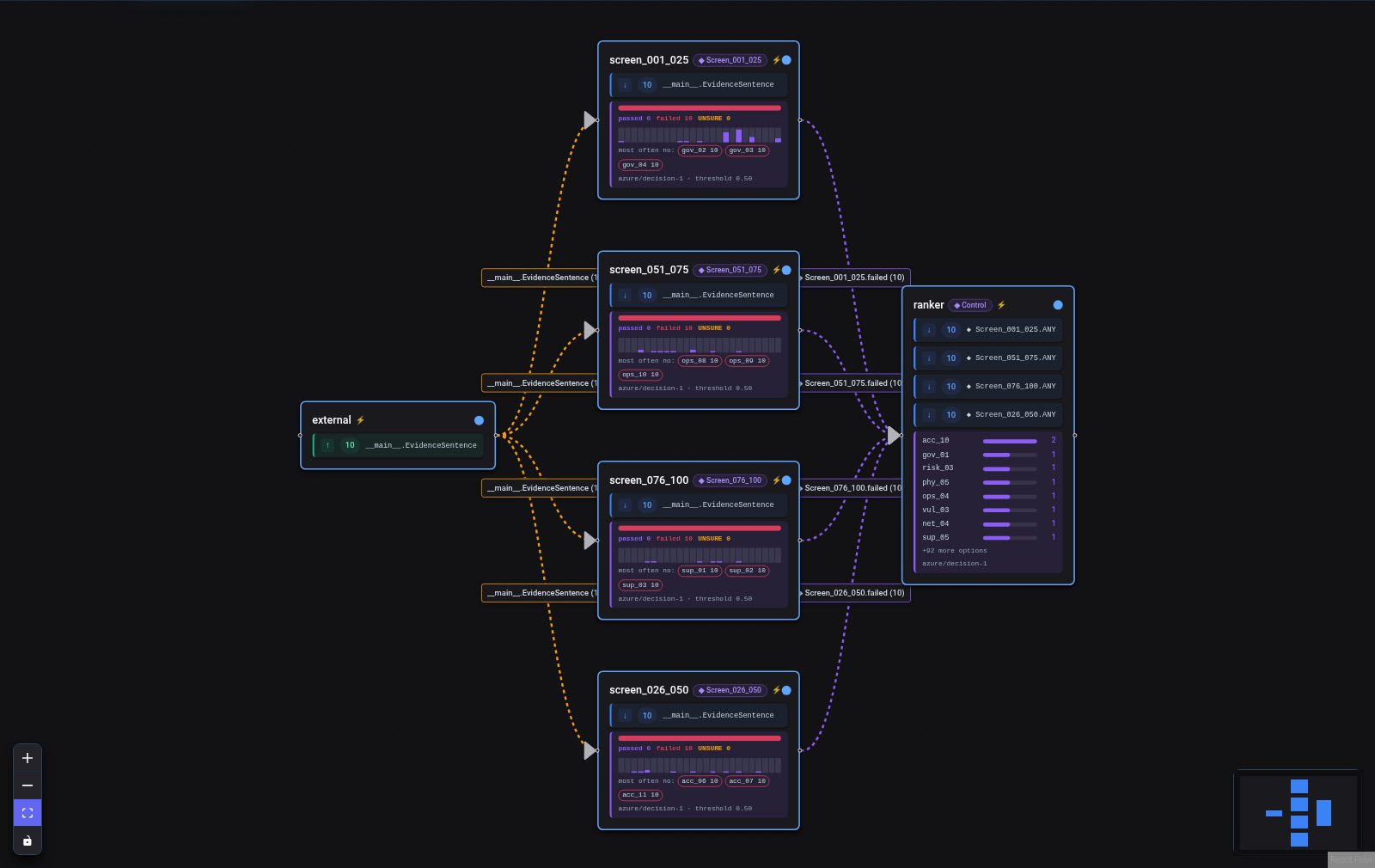
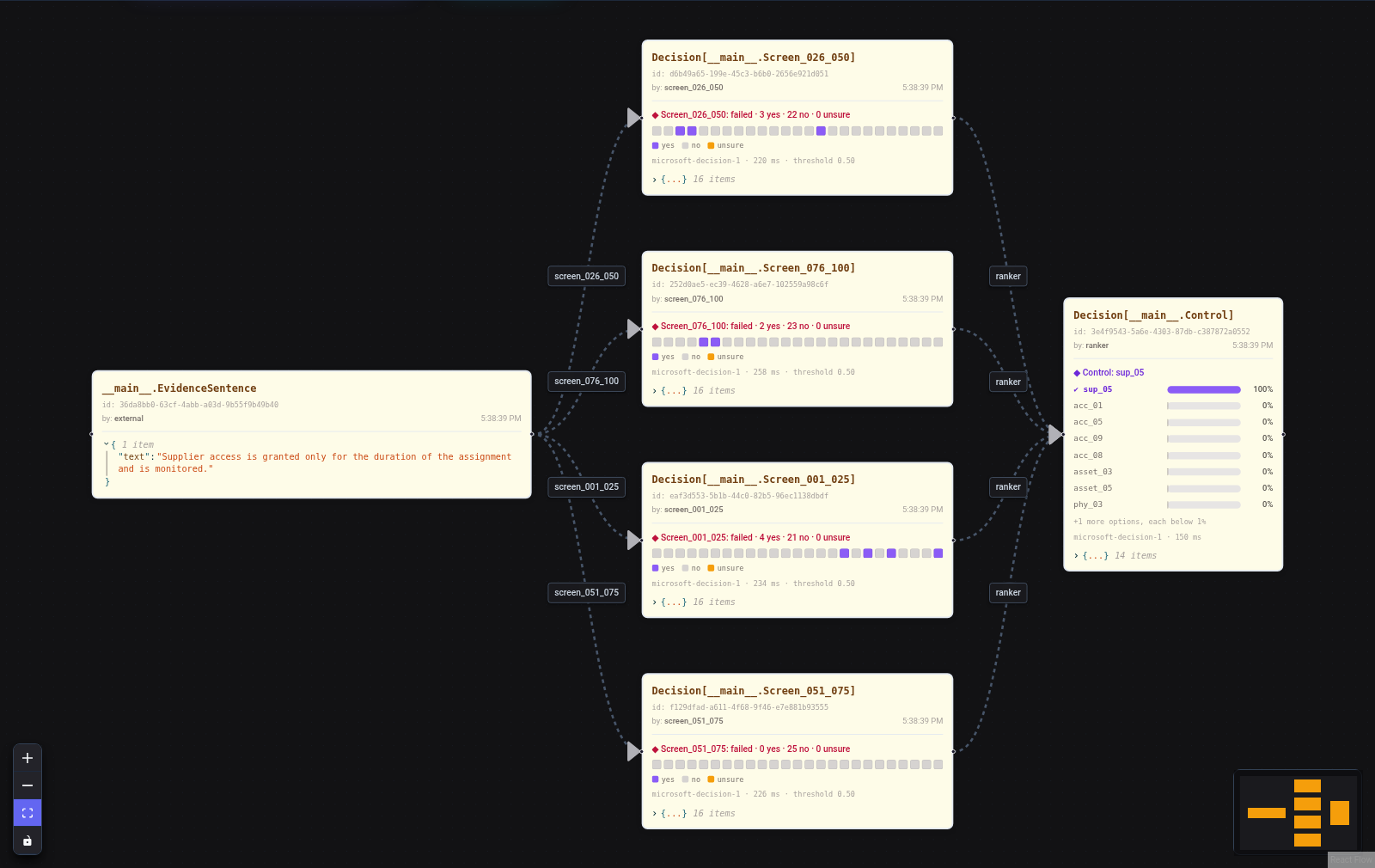
Separate screen nodes each check a slice of a catalog in parallel. A ranker waits for all screens of a document, receives the document itself and ranks the controls that passed:
                  ┌── screen_001_025 ──┐
EvidenceSentence ─┼── screen_026_050 ──┼──> ranker ──> Decision[Control]
                  ├── screen_051_075 ──┤
                  └── screen_076_100 ──┘
SCREENS = [
    Checklist.from_items(f"Screen_{s + 1:03d}_{s + 25:03d}",
                         {c["id"]: c["text"] for c in catalog[s : s + 25]},
                         question="Does this statement show that this control is implemented?")
    for s in range(0, 100, 25)
]
for screen in SCREENS:
    flock.agent(screen.__name__.lower()).consumes(EvidenceSentence).decides(screen, threshold=0.5)

flock.agent("ranker").consumes(*(s.ANY for s in SCREENS)).decides(Control, options=passes)
Screens are yes/no checklists rather than choices. A choice spreads its probability over its own slice, so an unrelated screen would still pass some option; yes/no answers are comparable across screens, which a threshold needs. Every screen is its own node, with its own model, threshold and scaling, and the dashboard shows each step:
Choosing one of many options: three ways
06_control_mapping_tournament.py runs all three on the same 10 evidence sentences and 100 controls (Microsoft-Decision-1):
| Way | Right | Median latency | Requests per sentence | When to use it |
|---|---|---|---|---|
| One choice | 10/10 | 182 ms | 1 | The options fit into one question (up to 255) |
| Tournament in one node | 10/10 | 388 ms | 2 | A large catalog, as one decision with a bracket |
| Screening network | 10/10 | 441 ms | 5 | Separate steps, each with its own model, threshold and scaling; screens that are useful on their own |
The network's latency is its slowest screen plus the ranker. The right control was among the network's passes for every sentence, with a median of 5 passes per sentence.
Thresholds and the UNSURE branch
With threshold=0.8 the decision is firm only when the chosen option's probability is at least 0.8. Otherwise choice is UNSURE and only Route.UNSURE subscribers run, typically an LLM agent or a human-in-the-loop step. This is a confidence-gated cascade: keep the confident verdicts, escalate the rest.
A refused question (OpenAI's Decisions API can refuse a question and still answer the others) becomes a decision with choice=UNSURE, refused=True, best_guess=None and no probabilities, so it lands in the UNSURE branch instead of failing the execution.
Calibration is per task, not global. Pick each decider's threshold on that decider's own data. Recorded decisions (persistent store, traces) make it cheap to replay inputs against another model before switching.
Escalation cascades
escalate= asks another decision model about what the first one was not sure about, before anything routes to UNSURE:
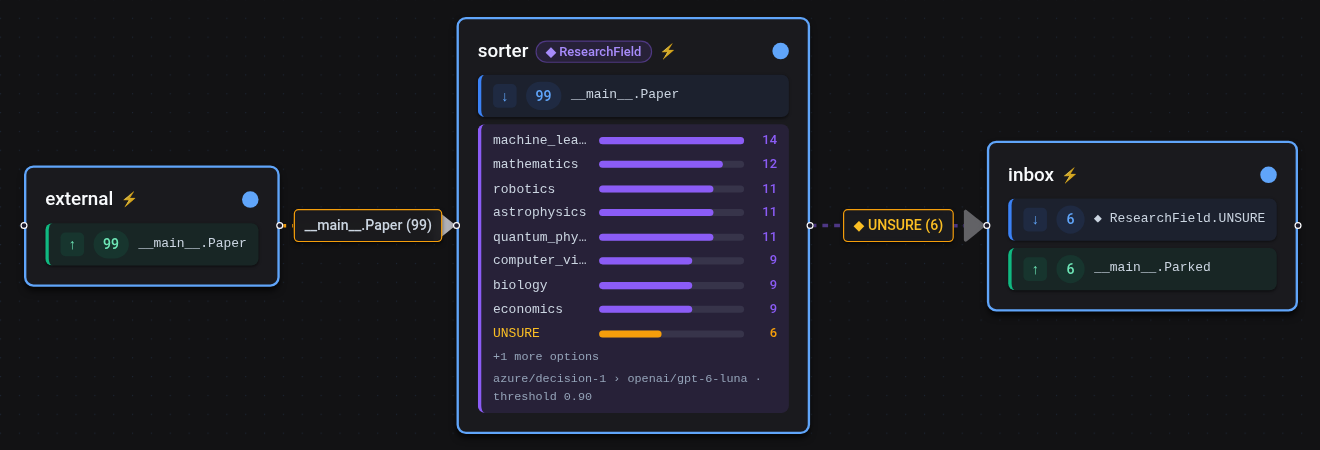
flock.agent("sorter").consumes(Paper).decides(
    ResearchField,
    model="azure/decision-1",
    escalate=["openai/gpt-6-luna"],
    threshold=0.9,
)
flock.agent("inbox").consumes(ResearchField.UNSURE).publishes(Parked)
- The decider's own model answers every question.
- A question whose answer is not firm (below
thresholdor refused) is asked again by the first model inescalate=, then by the next one, and so on. A tier gets only the questions the tier below was unsure about: of.decides(Route, Urgent)onlyUrgentmay go up, and of a Checklist only its unsure items. - The last tier's answer is the decision. Still unsure after the last tier, it routes to
UNSUREas usual.
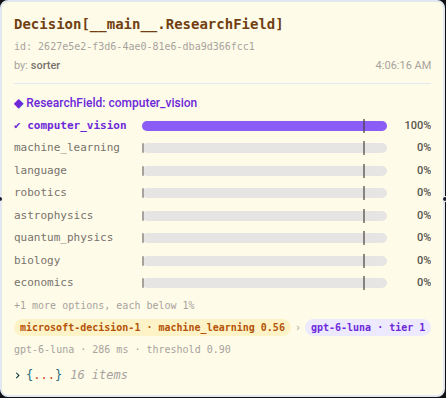
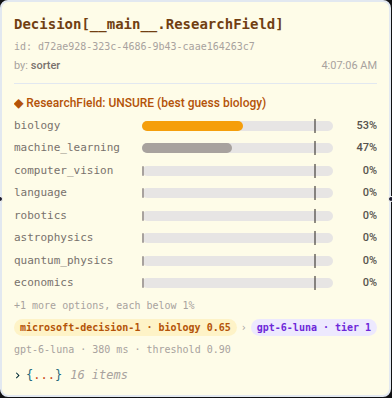
The decision's tier says which tier answered (0 for model=, 1 for the first model in escalate=) and model names that tier's model. attempts lists the earlier answers, oldest first: each tier's model, choice, probabilities, confidence and refused; for a Checklist, the model and the results of the items that went up. Subscriptions and handles do not change: ResearchField.computer_vision runs whichever tier answered.
Each tier is a provider string or instance like model=, with its own share of decision_rate_limit. Every tier must accept images when the inputs hold an Image. escalate= cannot be combined with tournament= yet.
On 100 arXiv abstracts (nine fields, threshold 0.9), Microsoft-Decision-1 answered 82 papers firmly; gpt-6-luna answered 12 of the other 18, and 6 went to UNSURE. That took 118 requests, against 100 for each model alone; the stronger model saw 18 papers instead of 100 (07_escalation.py).
In the dashboard, a decider lists its cascade after its model (azure/decision-1 › openai/gpt-6-luna). An escalated decision shows its trail above the model line: every earlier tier's best guess and probability (amber), then the tier that answered:
Ensembles and voting
models= asks several decision models instead of one, and vote= decides:
flock.agent("sorter").consumes(Paper).decides(
    ResearchField,
    models=["azure/decision-1", "jev/jev-latest", "openai/gpt-6-luna"],
    vote="majority",
    threshold=0.8,
)
flock.agent("inbox").consumes(ResearchField.UNSURE).publishes(Parked)
Every model answers every question, concurrently. A model's answer is a vote for its choice when it is firm: at or above threshold and not refused.
vote= | Firm when |
|---|---|
"majority" (default) | more than half of the models vote for the same answer |
"unanimous" | every model votes for the same answer |
"mean" | the mean probability of the most probable answer reaches threshold |
Anything else, disagreement included, routes to UNSURE. A refusal is no vote and counts against a majority; when every model refuses, the decision is refused. Checklist items are voted one by one, each with its own result.
The decision's probabilities are the mean over the models that answered, its best_guess is the answer voted for (or the most probable on average), and model joins the models' names (microsoft-decision-1 + jev-1.13.0 + gpt-6-luna). votes lists every model's answer in the order of models=: model, choice, probabilities, confidence and refused; for a Checklist, the model and its result per item.
With options=, a question left with one candidate or none is decided without asking any model, so its votes stay empty. models= replaces model= and needs at least two models; every model gets its own share of decision_rate_limit and must accept images when the inputs hold an Image. It cannot be combined with escalate= or tournament= yet.
On the 100 arXiv abstracts (threshold 0.8, one run per vote on 2026-10-11, 08_voting.py), each model alone and the three votes over the same three models:
| Firm | Agree with arXiv | Of the firm ones | |
|---|---|---|---|
| Microsoft-Decision-1 alone | 87 | 81 | 93 % |
| Jev alone | 89 | 82 | 92 % |
gpt-6-luna alone | 95 | 91 | 96 % |
vote="majority" | 89 | 84 | 94 % |
vote="mean" | 84 | 81 | 96 % |
vote="unanimous" | 80 | 78 | 98 % |
A vote trades coverage for precision: the unanimous vote sorted fewer papers, and almost all of them correctly. In this task one model is clearly stronger, and gpt-6-luna alone sorts more papers at about the same precision as the majority. An ensemble pays off when no model is clearly best, when a wrong firm answer costs more than a review, or when disagreement between models should be visible as its own branch. It costs one request per model.
In the dashboard, a decider names its vote and models (majority of azure/decision-1 + jev/jev-latest + openai/gpt-6-luna), and a decision shows every model's vote: violet for a firm vote for the decision, amber for a firm vote that did not carry, grey for no vote (below the threshold or refused).
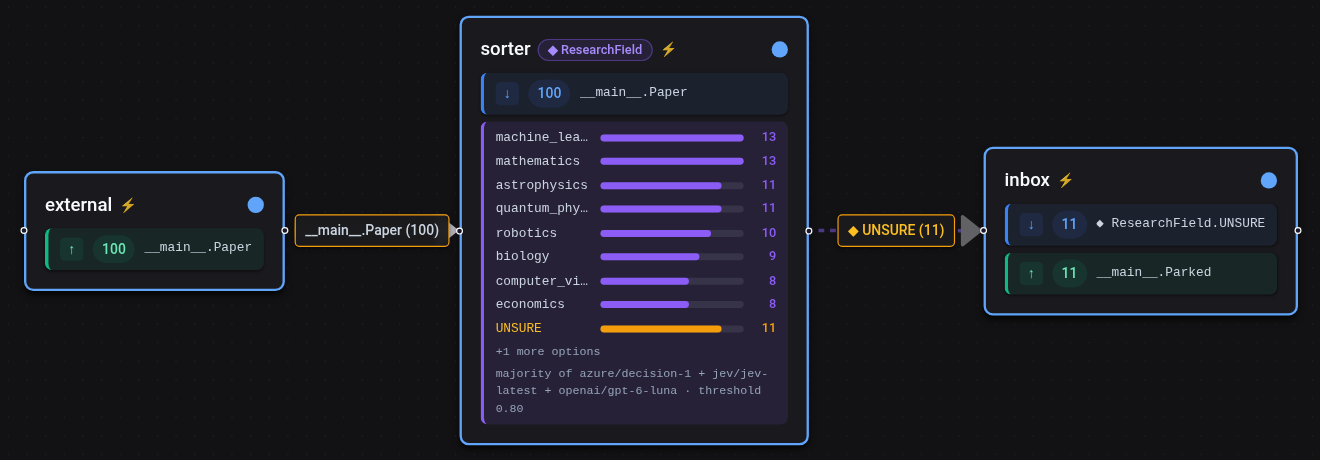
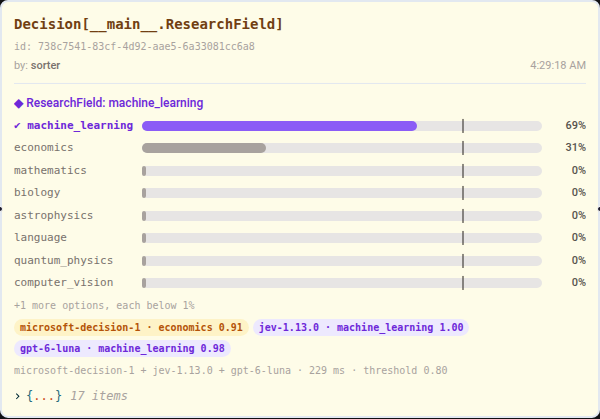
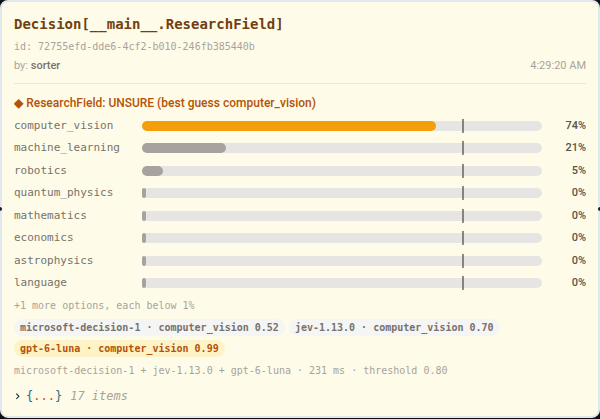
The mean bar of the chosen option can sit below the threshold marker on a majority decision: the threshold applies to each model's vote, not to the mean.
Shadow mode
shadow= lets a candidate model answer along with the live one, before switching to it:
flock.agent("sorter").consumes(Paper).decides(
    ResearchField, model="azure/decision-1", shadow="openai/gpt-6-luna", threshold=0.8
)
The shadow answers every question too, concurrently with the live model. Its answer is recorded in the decision's shadow and never routes: handles such as ResearchField.UNSURE see only the live choice. shadow holds the shadow's model, its choice under the same threshold (so it shows where the shadow would have routed), best_guess, probabilities, confidence, refused and latency_ms; for a Checklist, its choice (the outcome), best_guess, results and refused_items.
A failing shadow never fails the decision: a provider error, or images sent to a shadow without image support, is recorded as {"model": ..., "error": ...} and logged. A failing live model still fails the execution as before. After its own answer, the decision waits for the shadow at most shadow_timeout seconds (default 10); a slower shadow is cancelled and recorded as a timeout error, so it never holds up routing for long. latency_ms of the decision stays the live model's. shadow= combines with escalate=, models= and options=, and it cannot be combined with tournament= yet.
On the 100 arXiv abstracts (threshold 0.8, 09_shadow.py), with Microsoft-Decision-1 live and gpt-6-luna in the shadow:
| Firm | Agree with arXiv | Median latency | |
|---|---|---|---|
| live: Microsoft-Decision-1 | 88 | 82 | 166 ms |
shadow: gpt-6-luna | 95 | 91 | 140 ms |
The shadow would have routed 86 of the 100 papers the same way. Most of the other 14 are papers the live model was unsure about and the shadow sorted firmly; they are the papers to look at before the switch.
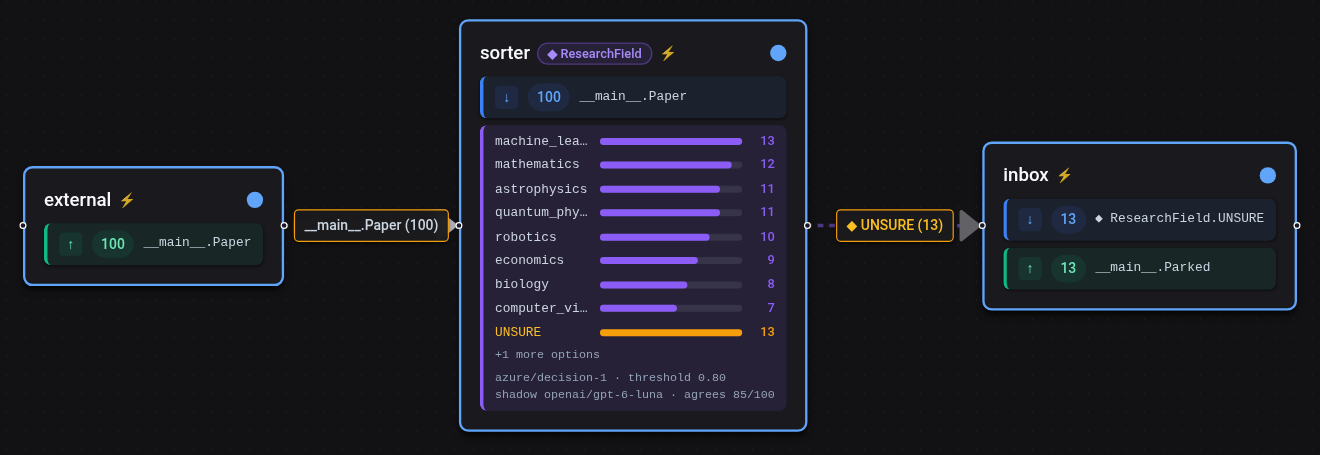
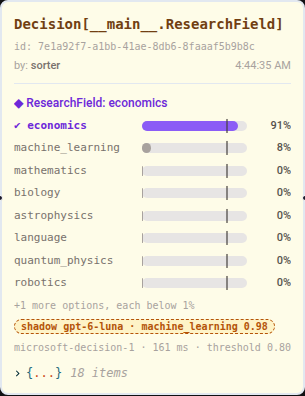
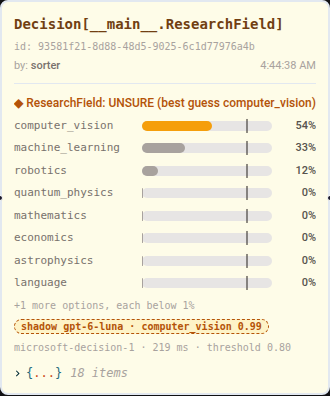
In the dashboard, the decider shows how often the shadow agreed (shadow openai/gpt-6-luna · agrees 85/100 in a second run), and a decision shows the shadow's answer in a dashed pill: violet if it would have routed the same way, amber if not, grey if the shadow failed.
Visibility
A decision inherits the visibility of its subject, so routing never widens who can read data. Agents that may not see the ticket do not see its decision either and are not triggered. If a decider consumes several inputs with different visibilities, it fails instead of guessing; pass visibility= to .decides() to choose the decision's readership explicitly.
Dashboard
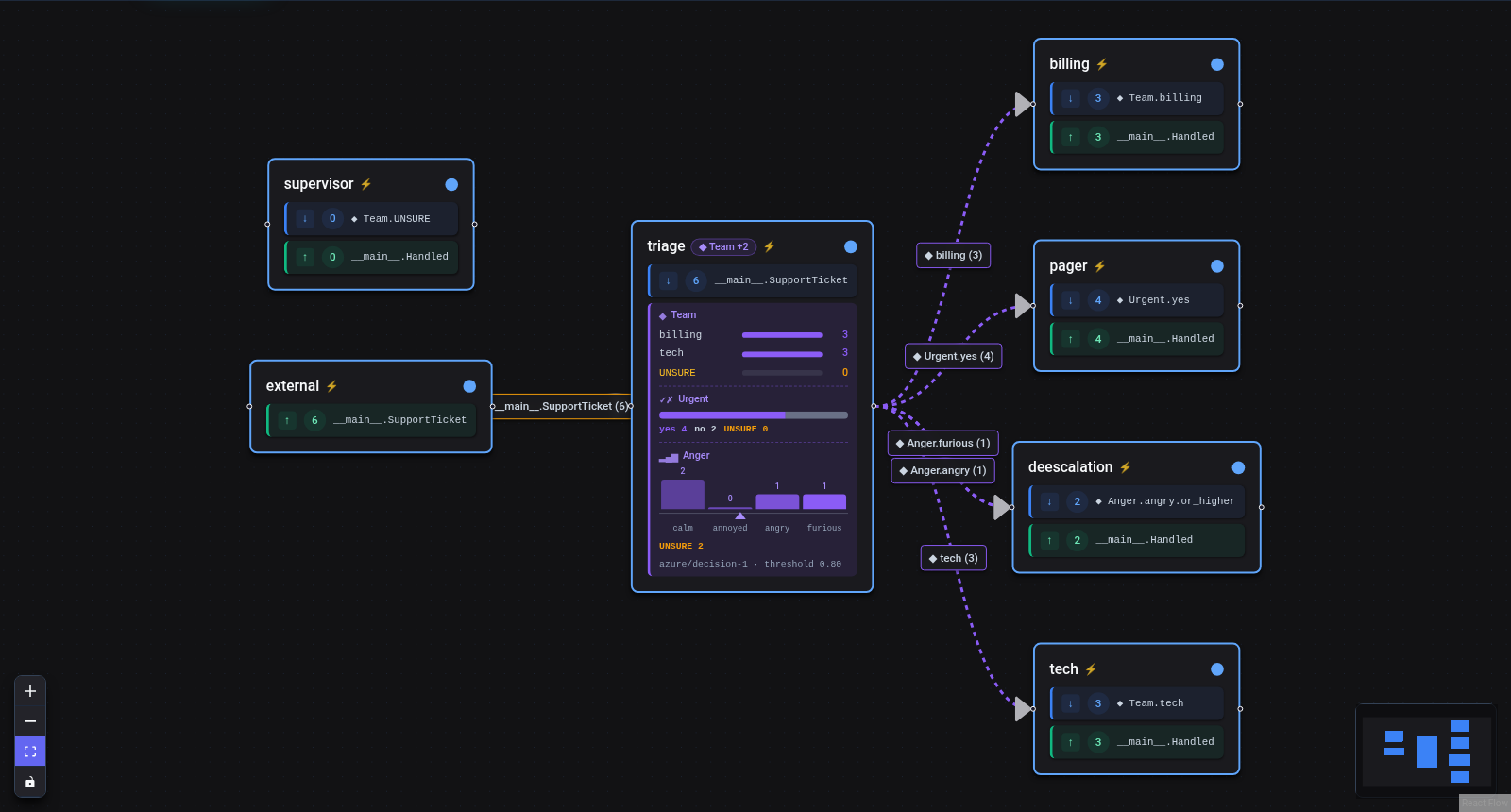
A decider node shows every question it asks, drawn by kind: option bars for a Choice, one bar split into yes, no and UNSURE for a YesNo, and a histogram of the levels in order for a Scale, with a marker at the mean weighted score. Edges carry the answer, qualified for yes/no and scale questions (Urgent.yes, Anger.angry):
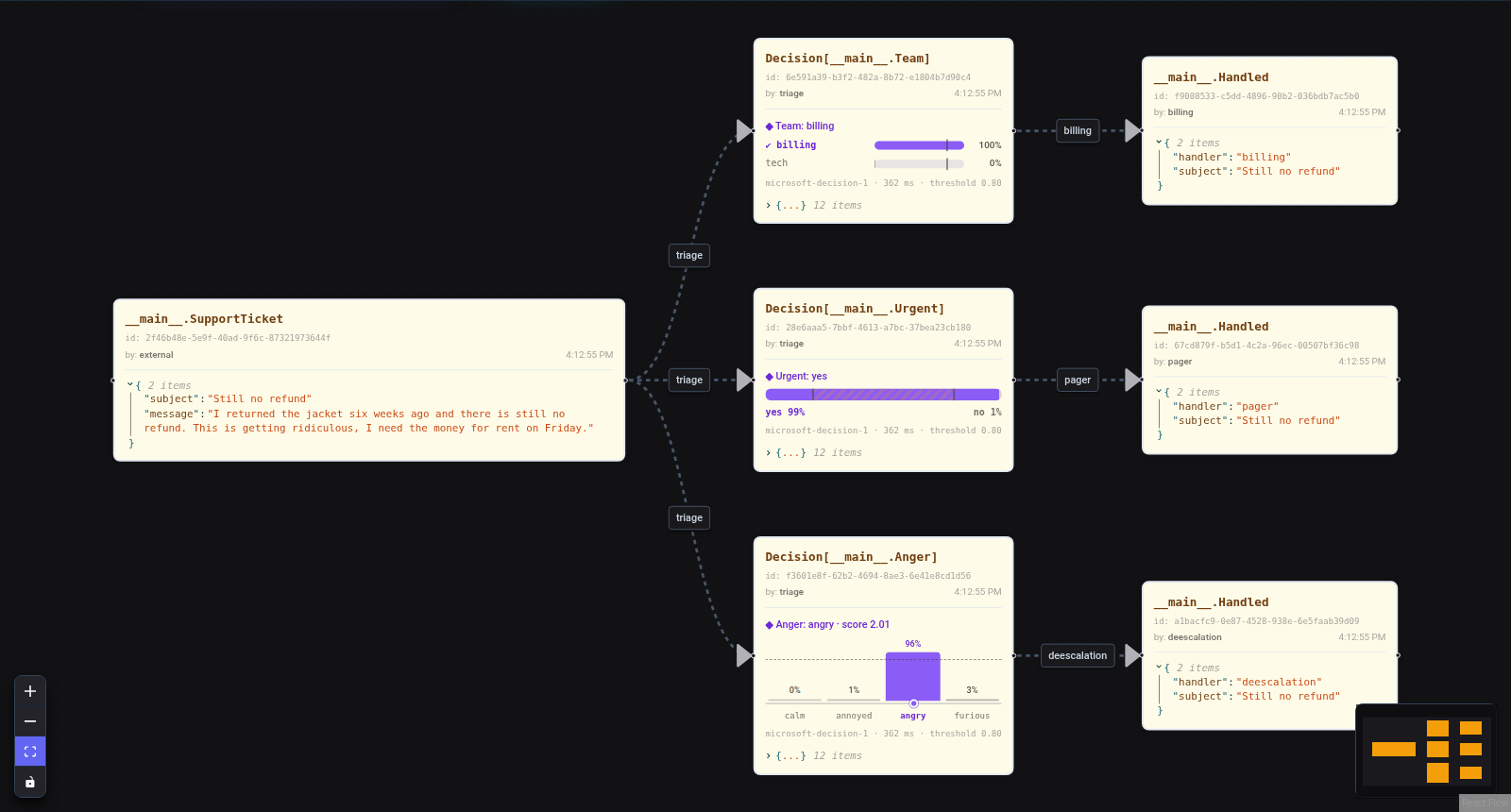
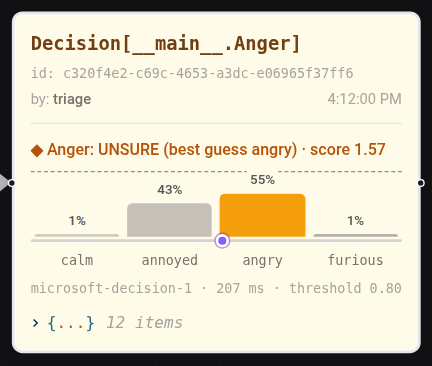
In the Blackboard View each decision shows its answer the same way. A yes/no decision is one bar from yes (left) to no (right); the hatched zone between the two threshold markers is where neither answer is firm. A scale decision shows its levels in order, the threshold as a dashed line and the weighted score as a dot on the axis:
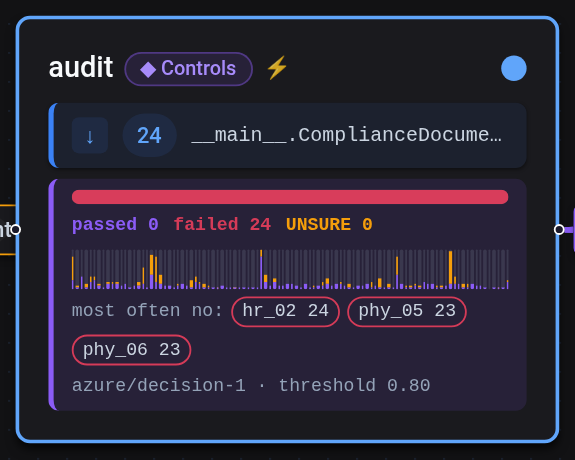
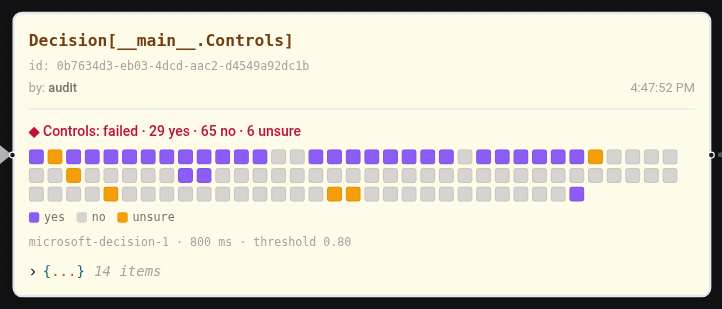
A checklist decider shows its outcomes, a strip with one column per item (the share of yes in violet and of unsure answers in amber across all decisions) and the items answered "no" most often. A checklist decision shows one cell per item:
Images
Decision models that accept images can decide about pictures. Put the picture into the artifact as a flock.Image field:
from flock import Choice, Flock, Image, flock_type


@flock_type
class ProductPhoto(BaseModel):
    sku: str
    photo: Image


class Condition(Choice):
    """Is the product in the photo damaged?"""

    intact = "No visible damage"
    damaged = "Cracks, dents, tears or broken parts"


flock.agent("inspector").consumes(ProductPhoto).decides(Condition, model="openai/gpt-6-luna")

await flock.publish(ProductPhoto(sku="A-17", photo=Image.from_file("a17.jpg")))
Imageholds the picture as a base64data:image/...URL, so it round-trips through stores, the REST API and the dashboard. Only inline data is accepted: Flock never fetches an image from a URL or a file path named in an artifact. Images over 20 MB or 50 million pixels are rejected when the artifact is created.Image.from_file(),Image.from_bytes()andImage.from_pil()scale the picture down tomax_side(default 1024 px) and re-encode it as JPEG (PNG when it has transparency). Re-encoding drops EXIF metadata such as GPS positions. Smaller images are faster: a local Clef model took 1.3 s for a 108 KB photo and 11 s for 1 MB.- The decider sends every
Imagein its inputs (also nested, in order) to the model; the text state shows<image 1>,<image 2>, ... in their place. - LLM agents receive
Imagefields as pictures too; see image inputs. - Limits, publishing paths and security rules for images: Images guide.
- A text-only provider refuses image inputs with a clear error instead of dropping the images.
| Provider | Images |
|---|---|
openai/<model> | yes (input_image parts) |
local/<name> | yes, if the served model has vision support (top-level images, raw base64) |
azure/<deployment> (Microsoft-Decision-1) | no |
jev/<model> | no |
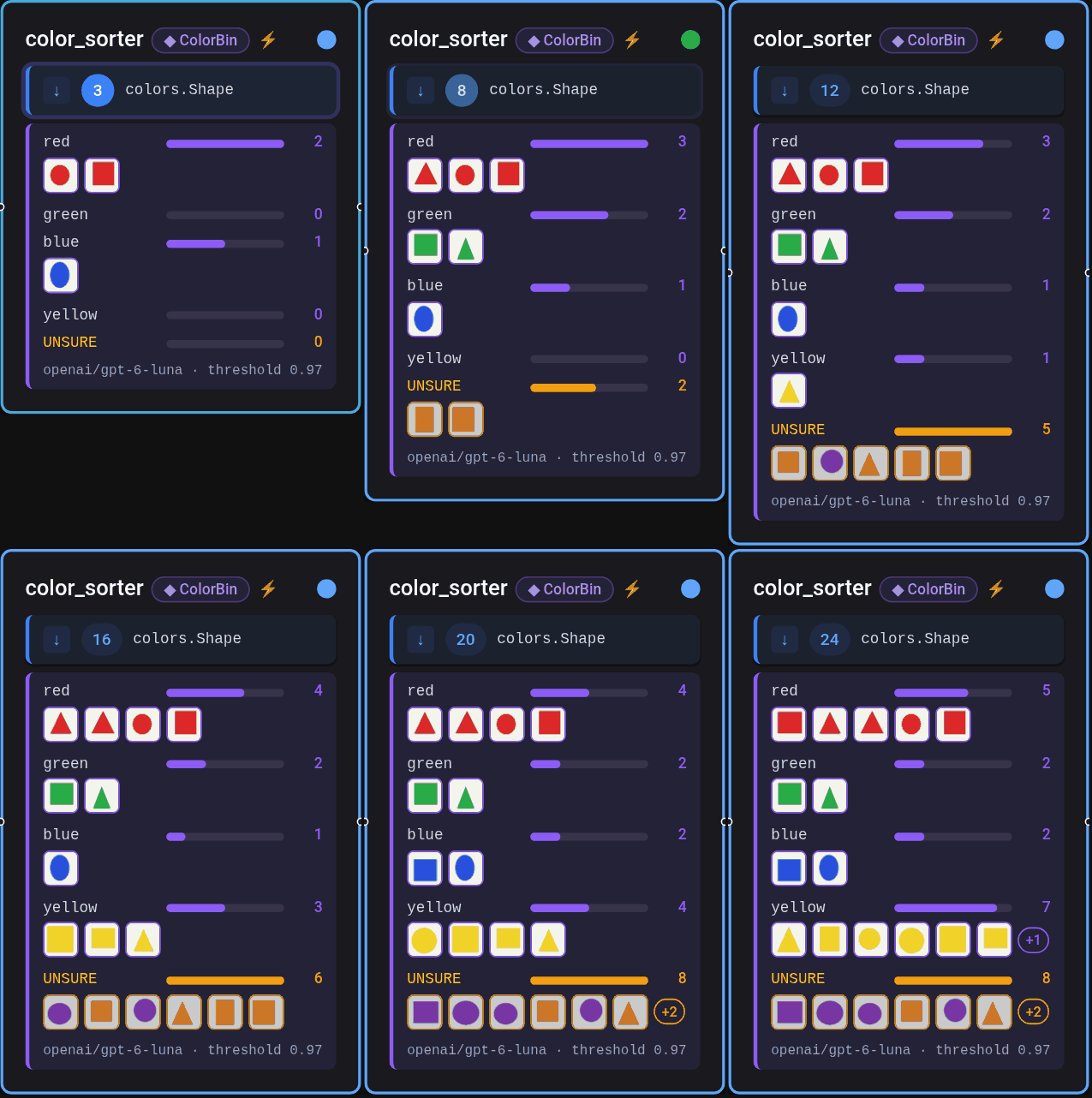
In the dashboard, a decider's options show lanes with thumbnails of the latest images sorted into each option, and a decision artifact shows the decided image next to its probabilities. Image fields render as thumbnails instead of base64 text.
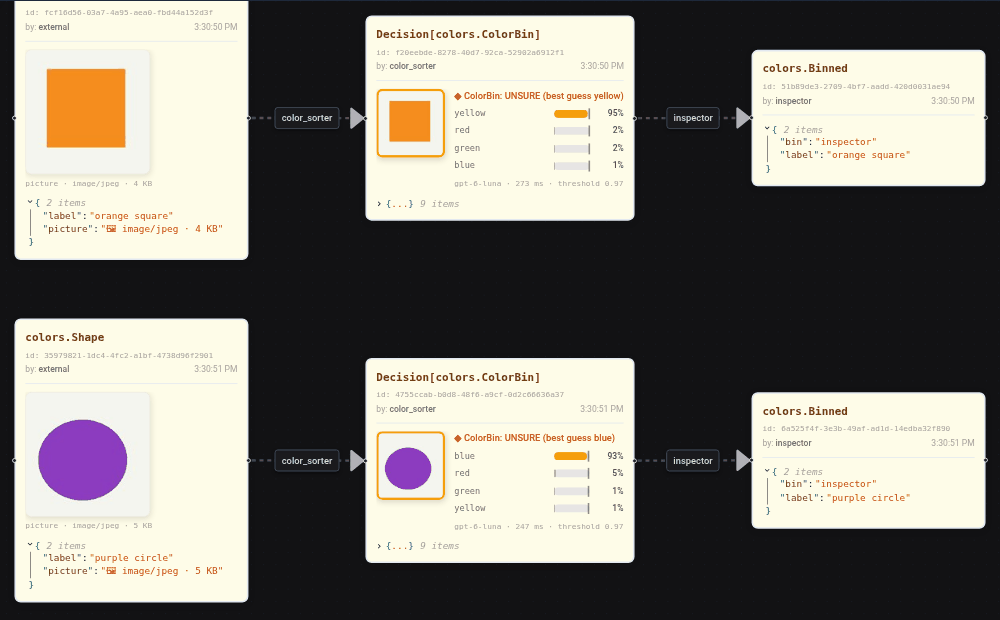
In the Blackboard View every image artifact shows its thumbnail, and each decision shows the image it decided on, its probabilities and the threshold:
Providers
| Model string | Protocol | Configuration |
|---|---|---|
jev/<model> | POST /v1/systemone | JEV_API_KEY (JEV_API_BASE overrides the endpoint) |
local/<name> | POST /v1/systemone | DECISION_API_BASE, default http://127.0.0.1:8080 |
azure/<deployment> | POST /v1/systemone on Azure AI Foundry (Microsoft-Decision-1) | AZURE_API_BASE, AZURE_API_KEY; AZURE_DECISION overrides the path (default /providers/microsoft/v1/systemone) or sets a full URL; azure/ alone uses AZURE_DECISION_DEPLOYMENT |
openai/<model> | POST /v1/decisions | OPENAI_API_KEY |
Set the decision model once for the whole flock instead of on every decider:
flock = Flock("openai/gpt-4.1", decision_model="azure/decision-1")

flock.agent("triage").consumes(Ticket).decides(Route)               # azure/decision-1
flock.agent("audit").consumes(Document).decides(Controls)           # azure/decision-1
flock.agent("painter").consumes(Swatch).decides(Color, model="openai/gpt-6-luna")  # explicit wins
The order is model= on .decides(), then Flock(decision_model=...) (a model string or a DecisionProvider), then the DEFAULT_DECISION_MODEL environment variable.
The live tests (FLOCK_LIVE_DECISIONS=1 uv run pytest tests/decisions/test_live_providers.py) run against azure/decision-1 by default and add the other providers when their configuration is present.
Local models
Any server that speaks POST /v1/systemone works with local/. llama.cpp's server runs Clef GGUF files with the decision head:
The model evaluates the whole prompt in one batch, so -b and -ub must cover the longest request.
Rate limits
Hosted decision models limit the requests per period. The Microsoft-Decision-1 deployment used by the examples, for example, allows 100 requests per minute. Two mechanisms keep deciders within such limits:
- Retries. A request answered with HTTP 429 (rate limited) or 503 (overloaded) is sent again, up to 7 times.
- The response's advice is the shortest wait:
retry-after-ms,Retry-Afterorx-ratelimit-reset-requests, which hold seconds on Azure and durations such as6m0son OpenAI. - On top comes a backoff that doubles from 0.5–1 s, with jitter. Azure advises the time until its next free request, often under half a second. A burst of rejected requests that all came back after exactly that would be rejected together again.
- No single wait exceeds 60 s. The shortest waits add up to just over a minute, one full rate-limit window.
- Each retry logs a warning, and
max_retries=on the provider classes changes the count.
- The response's advice is the shortest wait:
-
A request budget.
decision_rate_limitspaces out requests before the limit is reached:Each decision model gets at most this many request starts per period (
"N/s","N/min"or"N/h"). The budget is shared by every decider of the flock that uses the model, whichever way the model was set. Requests over the budget wait for a free slot in arrival order, and retries count against it. Withoutdecision_rate_limit, requests go out at once.
The budget covers one flock. When other clients share the deployment, the retries absorb their share of the limit. Waiting time is part of a decision's latency_ms.
Errors
Provider failures (unreachable server, HTTP errors, answers with unknown options) fail the decider's execution and publish a WorkflowError, as does an HTTP 429 or 503 that persists through all retries. Error messages name the provider and the HTTP status only, never the response body, because a body can echo the decided data.
Testing
FakeDecider answers with fixed probabilities or with a function of the state and records every request:
from flock.decisions import FakeDecider

decider = FakeDecider({"billing": 0.9, "shipping": 0.05, "tech": 0.05})
flock.agent("triage").consumes(Ticket).decides(Route, model=decider)

await flock.publish(ticket)
await flock.run_until_idle()

state, question = decider.calls[0]
For a decider with several questions, give the probabilities per question name. refuse= makes it refuse questions; decider.requests holds every request with all its questions:
decider = FakeDecider(
    {
        "Route": {"billing": 0.9, "tech": 0.1},
        "Urgent": {"yes": 0.8, "no": 0.2},
        "Anger": {"calm": 0.1, "annoyed": 0.2, "angry": 0.6, "furious": 0.1},
    },
    refuse={"Urgent"},  # optional
)
For a checklist, map its name to the probability of yes per item (or to a function of the state returning that); refuse single items as "Controls.restore_test":
Decision models or semantic subscriptions?
Both route artifacts by meaning, at different costs and guarantees:
Semantic subscriptions (semantic_match=) | Decision models (.decides()) | |
|---|---|---|
| How | Embedding similarity of the artifact text to a query, per subscriber | One model call per artifact answers a question with a probability per option |
| Runs | Locally (all-MiniLM-L6-v2), no API | Hosted (azure/, openai/, jev/) or a local server (local/) |
| Output | A similarity score per subscriber, not shared | A Decision artifact on the blackboard: probabilities, confidence, audit trail |
| Mutually exclusive branches | No: several subscribers can match one artifact | Yes: exactly one option, or UNSURE |
| Good for | Cheap relevance filters, "is this about X?" | Routing and classification you want to audit, threshold and replay |
What decision models are good at
They judge well when the answer can be read off the supplied state: routing, intent and topic classification, policy checks against given text. They are weak at reference-free judgments of taste or quality, where their confidence stops predicting their errors. They give no reasons, so let an LLM explain the low-confidence and failing cases. A decision model should not be the only gate that allows a risky action; let it deny or escalate, and let allowlists or people allow.
Example
examples/15-decisions/01_ticket_triage.py routes support tickets with Microsoft-Decision-1 (or any other provider) and sends ambiguous tickets to a supervisor. 02_arxiv_race.py races an LLM against the available decision models on 100 arXiv abstracts. 03_color_sorter.py sorts generated shapes into color bins from their images. 04_question_types.py asks a choice, a yes/no and a scale question about every ticket in one request. 05_compliance_checklist.py checks 24 fictional security documents against 100 controls and compares the answers with ground truth. 06_control_mapping_tournament.py maps evidence sentences to one of the 100 controls in three ways: a single choice, a tournament and a screening network. 07_escalation.py sorts the arXiv abstracts with a cascade of two decision models and shows which tier answered each paper. 08_voting.py lets three decision models vote on them and compares each model with the ensemble. 09_shadow.py runs a candidate model in the shadow of the live one and lists where it would have routed differently.